
Most corporate training is built to transfer information. A quiz is built to create a feeling. That difference — boring as it sounds when you say it out loud — explains everything about why one works and the other doesn’t.
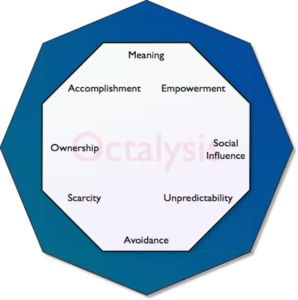
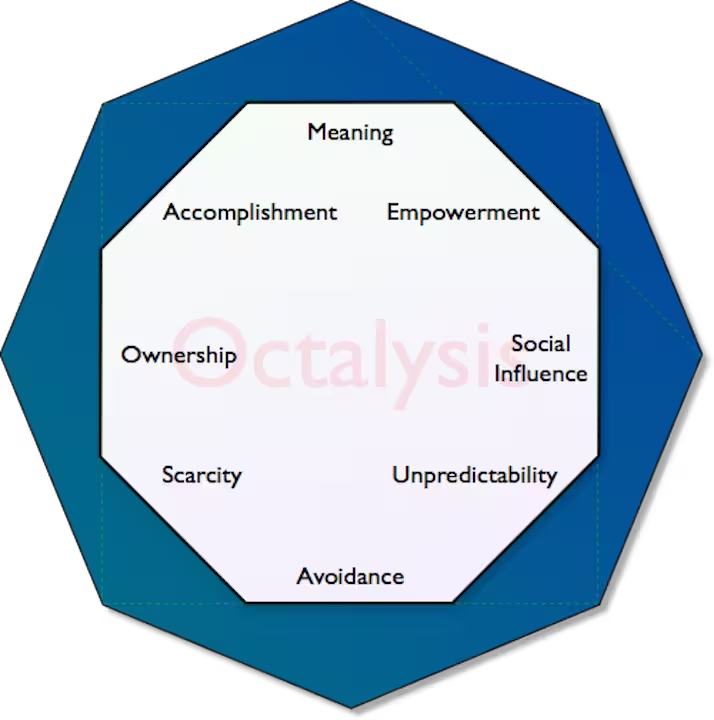
There’s a framework in gamification in corporate training that makes this precise. It’s called the Octalysis Framework, built by behavioural designer Yu-kai Chou after two decades of studying what actually makes humans engage with an experience — not just complete it, but genuinely want to be there. Octalysis maps human motivation across eight Core Drives. It’s been cited in over 4,000 academic publications and applied by companies like Google, LEGO, and Microsoft.
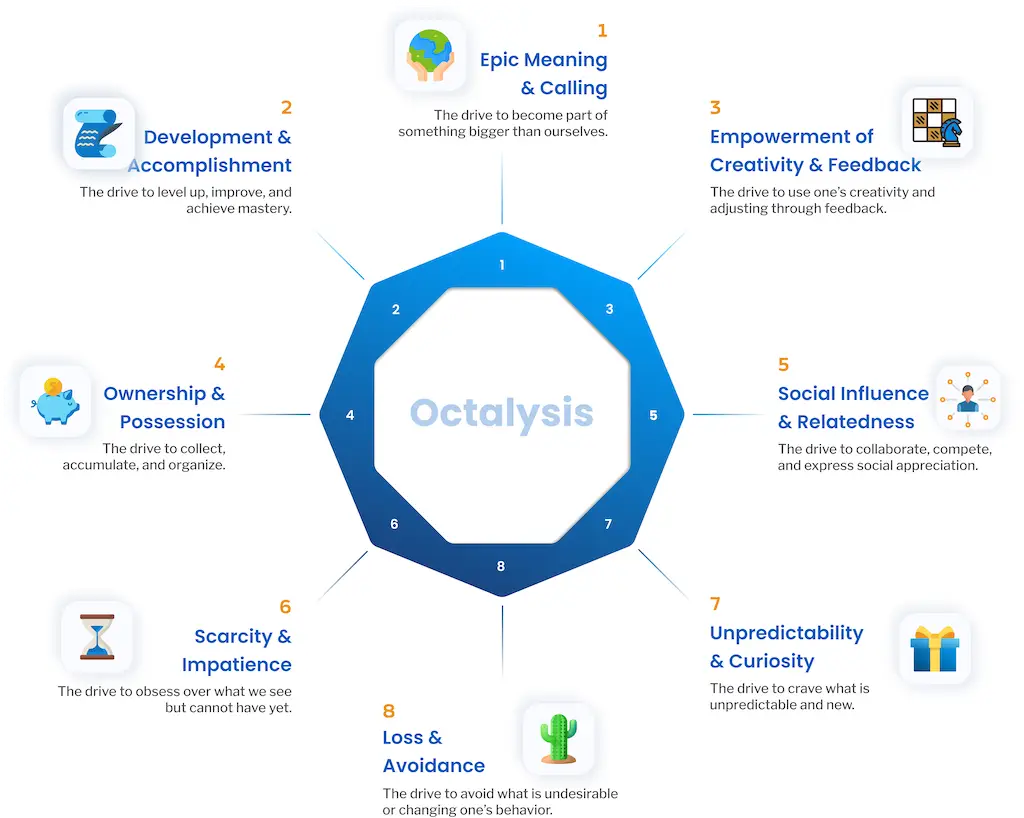
We ran a corporate quiz event last month and decided to map it against Octalysis in real time. What we found was not subtle. A single 90-minute quiz event fired six of the eight Core Drives — without us deliberately engineering any of it. The drives just fire. That’s what a good quiz does. Here’s what the map looks like.
What Octalysis Actually Is
The standard critique of gamification is fair: most of it is fake. Add a leaderboard, hand out a badge, call it gamified. It doesn’t work long-term because it only addresses one of the eight drives — Development and Accomplishment. People collect the badge, lose interest, and stop.
Chou’s argument is that meaningful gamification requires multiple Core Drives firing simultaneously. The drives sit on two axes. White Hat drives — Epic Meaning, Accomplishment, Empowerment, Ownership — feel intrinsically good. Black Hat drives — Social Influence, Scarcity, Unpredictability, Loss Avoidance — feel urgent. The best experiences balance both. Games do this naturally. Traditional corporate training activates almost none of them.
A corporate quiz — a well-designed one, not a PowerPoint with multiple choice — activates most of them at once. Here’s the breakdown, drive by drive.
Core Drive 2: Development and Accomplishment
This one is obvious, so we’ll get it out of the way fast. People want to feel like they’re progressing and getting things right. A quiz gives you immediate, unambiguous feedback on that — you answered correctly, your team scored, the points went up. No waiting for an appraisal cycle. No wondering if your manager noticed. The feedback is instant and public.
The data on this is clear. According to AmplifAI’s 2026 gamification research, 83% of employees who undergo gamified training feel motivated, compared to 28% with traditional methods. The gap is not marginal. It’s the difference between a room that’s alive and one where people are waiting for the session to end.
Core Drive 5: Social Influence and Relatedness
The moment you divide people into teams, something shifts. It’s not just that they want to win. They don’t want to let their team down. Those are different motivations and the second one is much stronger.
Social Influence is the drive that makes people stay late at a quiz — not because the questions are exceptional, but because their team needs them. It’s the drive that makes the finance team suddenly care about knowing the company’s founding year. It manufactures stakes where there were none before. The quiz master’s job, partly, is to let that social dynamic breathe. Give teams time to confer. Make the conferring visible. Let the room hear the debate. The social energy is half the event.
Core Drive 7: Unpredictability and Curiosity
This is the most underrated drive in corporate learning, and the one that traditional training ignores completely. Unpredictability is what makes a slot machine addictive. It’s what makes a good novel hard to put down. And it’s what makes a well-crafted quiz question genuinely exciting to hear.
When a question is read out loud and nobody in the room is certain of the answer, there’s a moment — before the buzz, before the conferring — where the brain is working hard and genuinely doesn’t know what comes next. That moment is cognitively irreplaceable. It’s active retrieval under uncertainty, which is exactly the condition under which information gets encoded into long-term memory. Not passive reception. Not re-reading a slide. Struggling to retrieve something you half-know, with something at stake.
The audio-visual round amplifies this further. An image clue, a sound clip, a video fragment — the brain gets curious before it even knows what the question is. That curiosity is the engagement engine.
Core Drive 8: Loss Avoidance
This is where the buzzer round gets its electricity. In most quiz formats, buzzing wrong costs you points. Your team doesn’t just lose the opportunity to answer — they lose the points they had. Loss Avoidance is a Black Hat drive, meaning it creates urgency through the fear of something being taken away.
Watch what happens in a room when a team buzzes wrong in a high-stakes round. The energy changes. The other teams lean forward. The team that got it wrong is suddenly desperate to recover. Nobody is on their phone. Nobody is thinking about their next meeting. The entire room is in that room, because something real just happened and the consequence was immediate.
A training slide cannot do this. A webinar cannot do this. An e-learning module cannot do this. Loss Avoidance requires stakes, and stakes require a live format with real-time consequences. That’s a quiz.
Core Drive 1: Epic Meaning and Calling
This one needs a good quiz master to unlock — it doesn’t happen automatically. Epic Meaning is the drive that fires when participants feel they’re part of something bigger than themselves. In a quiz context, it’s the difference between “we’re answering trivia questions” and “we’re representing our department in a company-wide championship.”
Framing matters enormously here. When the quiz is presented as a tournament — with proper stages, eliminations, a genuine prize, and ceremony around the winner — participants don’t feel like they’re at a team lunch. They feel like they’re competing. That feeling is Epic Meaning, and it’s why the best quiz events still get talked about six months later. The winning team didn’t just win. They won something.
This drive also explains why company-knowledge rounds land harder than general knowledge rounds in a corporate context. Questions about the company’s history, products, and milestones tell employees that the organisation’s story matters — and that knowing it matters. That’s a meaning signal, not just a trivia challenge.
Core Drive 6: Scarcity and Impatience
The timed question. The power play. The final round where only two teams remain. These are all Scarcity mechanics — moments where the opportunity to act is limited and the window is closing.
A 30-second timer on a buzzer question is a Scarcity mechanic. A “steal” opportunity — where a rival team can answer a question your team got wrong — is a Scarcity mechanic. A sudden death tie-breaker is Scarcity at its most raw. The brain responds to all of these with the same urgency it would use in a genuinely high-stakes situation. Not because the stakes are actually that high, but because the format engineers the feeling of high stakes. That’s what great game design does.
The Two Drives a Quiz Doesn’t Fire (And Why That’s Fine)
Octalysis has eight Core Drives. A quiz event – even a good one doesn’t naturally fire all eight. Core Drive 3, Empowerment of Creativity, is about expressing yourself and seeing the results of your choices. A quiz is mostly right-or-wrong, which limits creative expression. And Core Drive 4, Ownership and Possession, is about building and accumulating things – a virtual goods mechanic that doesn’t translate cleanly to a live event.
You can engineer both into a quiz if you want to — a themed round where teams name themselves and craft a “team identity,” or a points-banking mechanic where teams hold accumulated currency across multiple sessions. These are worth exploring for organisations that want a repeat quiz format or a year-long quiz programme. For a one-off event, six drives firing well is more than enough. Most corporate experiences fire one or two, badly.
How Gamification in Corporate Training Changes Your Event Design
If you’re planning a corporate quiz event, the Octalysis lens gives you a concrete design checklist beyond “it should be fun.” Each drive maps to a specific design decision:
- CD1 (Epic Meaning): Frame the quiz as a tournament, not an activity. Give it a name. Have proper stages. Make the ceremony real.
- CD2 (Accomplishment): Use live scoring with visible point updates after every round. Make progress tangible.
- CD5 (Social Influence): Randomise team composition across departments. Cross-functional teams fire this drive harder than departmental ones.
- CD6 (Scarcity): Include at least one timed round and a steal mechanic. Limits create urgency.
- CD7 (Unpredictability): Include an AV round — image, audio, or video clues. The brain gets curious before the question is even asked.
- CD8 (Loss Avoidance): Use negative marking in buzzer rounds. The threat of losing points is what makes the buzzer moment electric.
This is the actual design thinking behind how we structure every corporate quiz event at Quiz Granny. Not instinct. Not “it feels right.” Format decisions are deliberate, and they’re made against a framework that has decades of behavioural science behind it.
If you want to talk through how this applies to your specific event — the occasion, the audience, the outcome you’re after — get in touch here or book a call directly. We’ll show you what a well-designed event looks like for your context, drive by drive.
Quiz Granny designs and hosts professional quiz events for corporates and educational institutions across India. Every format decision we make is deliberate — built on engagement science, not guesswork.
What is the Octalysis Framework in gamification?
The Octalysis Framework is a behavioural design methodology created by Yu-kai Chou that maps all human motivation into eight Core Drives: Epic Meaning, Development and Accomplishment, Empowerment of Creativity, Ownership and Possession, Social Influence, Scarcity and Impatience, Unpredictability and Curiosity, and Loss Avoidance. It is used to design products, events, and learning experiences that engage people sustainably — beyond simple points and badges. The framework has been applied by Google, LEGO, and Microsoft, and has over 4,000 academic citations.
How does gamification improve corporate training outcomes?
Gamification improves corporate training by replacing passive information delivery with active engagement mechanics — competition, immediate feedback, social dynamics, and real-time stakes. Research shows that 83% of employees who undergo gamified training feel motivated, compared to 28% with traditional methods. Gamified learning also reaches a 90% completion rate versus 25% for non-gamified programs. The key mechanism is active retrieval under uncertainty, which is the condition under which information gets encoded into long-term memory most effectively.
Why do corporate quiz events work better than standard training sessions?
A corporate quiz activates multiple Core Drives simultaneously — social competition, loss avoidance, unpredictability, and accomplishment — creating genuine engagement rather than passive compliance. Standard training sessions typically activate none of these drives. The live, competitive format also creates the conditions for active retrieval, where participants must struggle to recall information rather than simply receive it. That retrieval effort is what makes knowledge stick. Quiz Granny designs each event format around these engagement principles, not just content.
What makes a corporate quiz format well-designed?
A well-designed corporate quiz format deliberately engineers multiple engagement drives: it frames the event as a tournament rather than an activity (Epic Meaning), uses live scoring with visible updates (Accomplishment), randomises teams across departments (Social Influence), includes a timed or steal mechanic (Scarcity), has an audio-visual round (Unpredictability), and uses negative marking in buzzer rounds (Loss Avoidance). Most corporate quiz events fire one or two of these drives accidentally. A professionally designed event fires all of them on purpose.